Apollo turns a wholesale buyer’s pasted list into a priced order
It sits in front of the distributor’s ERP, so buyers reorder without emailing a rep or clicking through a catalog. They paste whatever they have: product codes, plain descriptions, a PO number. Apollo prices it against their account, checks stock, and says plainly when it can’t.
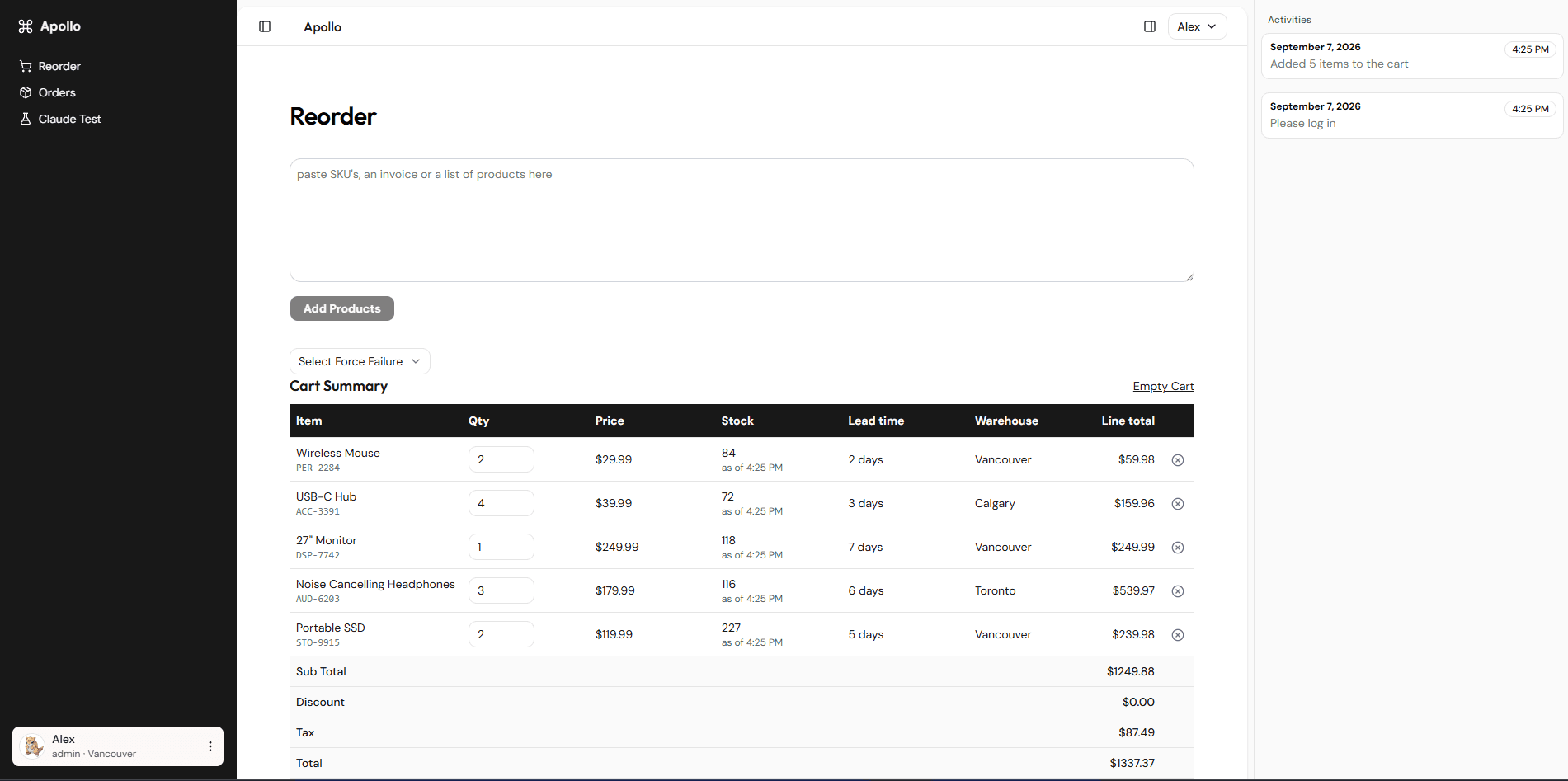
A demo build, running against a mock ERP: the system a distributor runs its inventory on.
How a paste becomes an order
A pasted list arrives in whatever shape the buyer sent it, so the first job is organizing it. That is the part Claude does, through custom tools that hold its answer to a fixed shape: a quantity, a unit, a product, and how confident it is.
From there Apollo’s own logic takes over. Lookups, discounts, and who may see which field each have exactly one correct answer, so Apollo works them out directly. The rest is failure handling. A stock check that times out falls back to the cached figure and shows its age, or says plainly that stock cannot be confirmed. A code that matches nothing returns the closest few products rather than a dead end. Every step writes a line to the activity log.
The buyer pastes anything
Codes, plain words, a PO number, or all three at once.
Claude organizes it
Reads the paste into line items: a quantity, a unit, and which product is meant.
Apollo checks it
Codes are looked up, misses come back with close matches, pricing and stock come from the account.
The buyer reviews
Adjust quantities, swap in a suggestion, remove a line. The cart reprices after every change.
The buyer places the order
It saves to the account's order history.
What buyers put up with
Four problems an agency owner watches repeat across client after client. Apollo fixes the buyer’s experience of each.
- Buyers do not browse. They reorder.
- A wholesale buyer already knows what they want, so there is no catalog to click through. One box takes product codes, a list written in plain words, or a previous PO number.
- Stock numbers are stale by the time the buyer sees them.
- A live check can hand back a count that is already hours old. Apollo shows the number with the time it was taken and a note to confirm before ordering, rather than presenting it as current.
- Price and availability depend on who is asking.
- The same product costs more, or shows different stock, to two different buyers. Apollo resolves both per account, so one paste produces a different table depending on who is signed in.
- Errors arrive as codes, not explanations.
- Every failure gets a specific answer. A timeout says the service took too long. A code that matches nothing comes back with the two or three closest products to pick from instead.